
Make music by drawing
Music Theory Drawing: Learn Scales, Keys and Rhythm by Drawing
Music theory drawing means learning how music works by drawing it: height is pitch, left to right is time, and every note you draw snaps to a scale. The scale is the secret. It limits your drawing to notes that sit well together, which is why any line sounds good, and switching the scale changes the mood of the very same drawing.
On this page
Most music theory for beginners starts with a staff, clefs and note names. Drawing lets you skip all that and hear the ideas directly. You draw a shape, you play it, you change one setting and play it again. Music theory drawing works because you hear each idea the moment you draw it. This guide explains the handful of ideas behind a draw-music canvas: scales, the pentatonic scale, major and minor, keys, tempo and rhythm. Keep the online draw music tool open in another tab and try each idea as you read.
The canvas is a simple music staff
A written music staff and a drawing canvas share the same two directions:
- Up and down is pitch. Higher on the canvas means a higher note, exactly like higher on a staff.
- Left to right is time. You read the canvas left to right, like a line of text. Here the loop is 4 bars of 16 steps, and a bar is 4 beats.
A grid like this is called a step sequencer: time is cut into equal steps and each step can hold notes. Drum machines and many music apps use the same idea. When you draw music on it, you are writing in a step sequencer without needing to know that's what it is.
Scales explained: why it sounds good
Western music uses 12 different notes before the pattern repeats one octave higher. If you could hit all 12 freely, many combinations would rub against each other and sound sour. The notes that sit right next to each other (a half step apart) are the main culprits.
A scale is a chosen set of those notes that belong together. When the canvas snaps every point of your line to a scale, the clashing choices simply disappear. That is why it sounds good no matter where your line goes: you can only land on notes that fit. It is the core of music theory drawing, and the reason a toddler's scribble and a careful sketch both come out musical.
The pentatonic scale: the beginner's safety net
The pentatonic scale has only 5 notes. It leaves out the two notes that create half steps, so there are no "clashing" neighbours at all. Any notes of a pentatonic scale sound good in any order, and even together. That is why it is the default "Happy" mood: draw anything and it sounds pleasant.
There are two common versions:
- Major pentatonic sounds bright and open (Happy).
- Minor pentatonic sounds softer and a little wistful (Dreamy).
Major vs minor
The full major scale has 7 notes and sounds bright, settled and familiar; most nursery rhymes and pop choruses live here (Classic). The minor scale also has 7 notes but sounds darker or sadder (Moody). The difference comes down to a few notes being one half step lower in minor. Draw the same line in Classic and then in Moody and you will hear the mood flip instantly.
Eight moods, eight scales
The Inkbeat app names its scales as moods so you can pick by feeling rather than by theory. The online tool includes four of them (Happy, Dreamy, Classic, Jazzy).
| Mood | Scale | How it sounds |
|---|---|---|
| Happy | Major pentatonic | Bright, can't-go-wrong |
| Dreamy | Minor pentatonic | Soft, floaty, slightly sad |
| Classic | Major | Familiar, cheerful |
| Moody | Minor | Dark, emotional |
| Mystery | Harmonic minor | Mysterious, exotic |
| Jazzy | Dorian | A jazzy, cool kind of minor |
| Blues | Blues scale | Gritty, bluesy |
| Zen | Japanese scale | Calm, spacious |
A few notes on the less familiar ones. Dorian is a minor scale with one brighter note, which gives it a jazzy, laid-back feel. Harmonic minor raises one note of the minor scale, creating a wide gap that sounds mysterious. The blues scale is a minor pentatonic with one extra "blue" note that adds grit.
Music theory drawing exercise: hear it in 5 steps
The best way to learn scales is to hear them side by side. This short music theory drawing exercise lets you draw music theory instead of memorising it. Try it in your browser:
- Draw one simple shape. Open the draw music online tool and draw a single wave from left to right with the piano colour.
- Play it in Happy. Press play and listen. This is the major pentatonic scale.
- Switch to Dreamy. Don't change the drawing. Play again and notice how the same shape now sounds softer and sadder.
- Try Classic and Jazzy. Classic adds the two "missing" notes of the major scale; Jazzy switches to Dorian.
- Change the tempo. Move the tempo slider and play once more. Same notes, different energy.
Tip: To train your ear, close your eyes after switching moods and try to name the feeling before you look. Within a few rounds you will tell major from minor without thinking.
Keys: the same tune, higher or lower
A key is the starting note of the scale. Changing the key moves the whole melody up or down but keeps its shape and mood. A song in C major and the same song in G major sound alike, just at a different height. The Inkbeat app offers all 12 keys, which is useful when you want a melody to sit higher or lower, or to match another track.
Rhythm: BPM, bars and beats
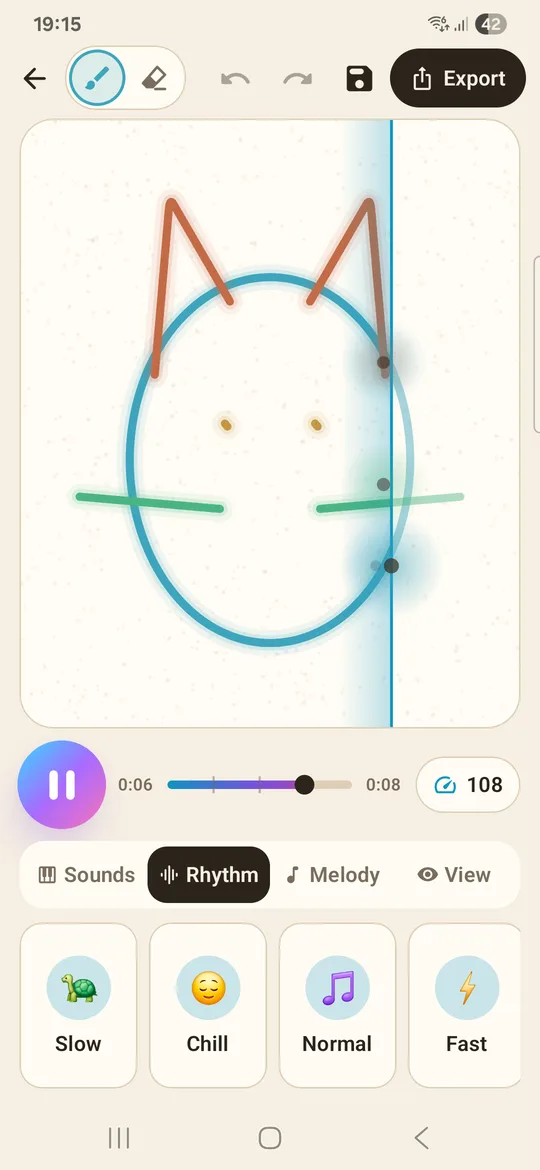
BPM means beats per minute, the speed of the music. In the app you choose from Slow 80, Chill 100, Normal 120, Fast 140 and Hyper 160 BPM; the online tool has a tempo slider. Around 80 to 100 BPM feels relaxed, 120 is a typical pop or dance pace, and 140 and up feels urgent.
A bar (or measure) groups the beats; here a bar is 4 beats, and the loop is 4 bars. Drums mark those beats: the kick usually lands on the strong beats, the snare or clap on the backbeat, and the hi-hat fills the steps in between. Adding bass and an arpeggio (the notes of a chord played one after another) under your drawing fills out the sound. Our guide to making music by drawing shows how to put it together.
Questions people ask
Can drawing help you learn music theory?
Yes. Drawing turns abstract ideas into something you can see and hear: height is pitch, left to right is time, and switching the scale on one drawing teaches the difference between moods faster than reading about it.
Why does every note sound good on a draw-music canvas?
Every note snaps to a scale, a set of notes chosen to fit together. With the pentatonic scale there are no clashing half steps at all, so any order of notes sounds pleasant.
What is the pentatonic scale in simple terms?
A five-note scale that leaves out the notes most likely to clash. It is used in folk, pop, rock and blues all over the world, and it is the easiest scale for beginners to improvise with.
What is the difference between major and minor?
Major sounds bright and happy, minor sounds darker or sadder. A few notes in the minor scale are one half step lower, which changes the whole mood.
What BPM should I use for my song?
Use 80 to 100 BPM for something calm, about 120 for a pop or dance feel, and 140 to 160 for high-energy tracks. Try the same drawing at two tempos and keep the one that fits.